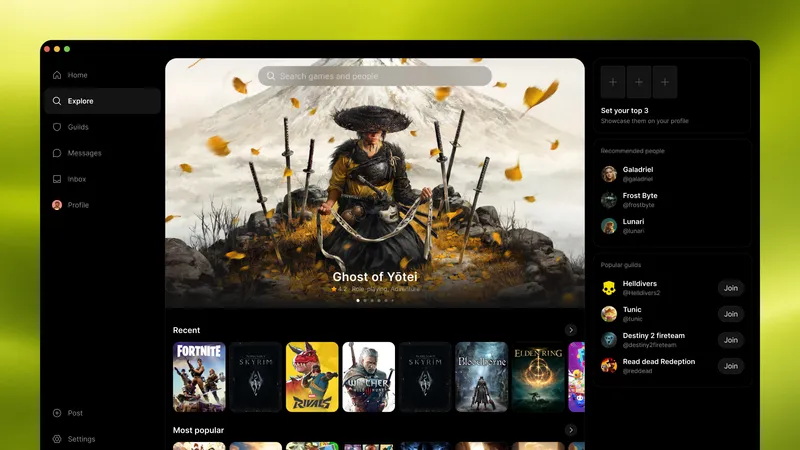

The Missing Layer
Gaming is larger and more accessible than ever. Cross-platform play is normal, subscription libraries expand monthly, and storefronts release hundreds of titles each year. Yet the infrastructure surrounding the player has not evolved at the same pace.
A player’s identity remains fragmented. Clips live on one platform, reviews on another, while achievements and friends lists remain locked inside individual ecosystems. Community conversations disappear into private servers and fast-moving feeds. Each space serves a purpose, but none brings these contributions together into a coherent record of taste and participation.
The industry has built powerful systems for selling and distributing games. It has not built a durable, portable social layer that belongs to the player.
Discovery Without Context
The abundance of games has created a problem of discoverability at scale.
Storefront algorithms reward momentum, social feeds reward spectacle, and aggregate scores flatten complex opinions into a single number. Major publishers can compete within this system, but independent studios often depend on timing, marketing budgets, and algorithmic luck.
Players face the other side of the problem. There is more choice than ever, but less clarity about which games genuinely suit their interests. Modern discovery is effective at showing what is popular, but far less effective at showing what is personally relevant.
The challenge is no longer access to games. It is access to meaningful context.
Reviews That Evolve
Most review systems treat opinion as fixed. A player leaves a score or a short comment, and that judgment remains frozen even as the game changes or their experience develops.
Lumin’s review timeline reflects how people actually play. It allows players to record their perspective over time, from first impressions through major updates, longer play sessions, and eventual completion. Instead of reducing an experience to a single verdict, it shows how that experience evolved.
This gives other players more useful context. They can see whether a game improves after its opening hours, loses momentum over time, or has changed substantially since launch. Developers gain a clearer view of how sentiment develops, while players build a visible history of thoughtful participation.
A review becomes more than a score. It becomes a record.
From Content to Identity
Gaming clips dominate social platforms because they are immediate and easy to share. Without identity or context, however, they are quickly replaced by the next moment in the feed.
Lumin connects these contributions. A clip can lead to a player profile, a review timeline, a history of participation, and a recognisable pattern of taste. Content becomes part of a broader identity rather than an isolated post.
Over time, those contributions form a lasting record of what a player enjoys, how they think about games, and how they participate in the community.
A Player-Centred Layer
Most gaming ecosystems connect hardware, storefronts, identity, and community within a single platform. Lumin is designed to sit across those boundaries.
That independence gives players an identity that is not tied to one device or storefront. It also gives developers another path to discovery, particularly when traditional platforms prioritise commercial momentum over long-term player response.
Lumin is not trying to replace existing ecosystems. It is building the connective layer between them.
Conclusion
Players will continue to share clips, write reviews, discover games, and form communities. The unresolved question is where those contributions can accumulate into something coherent and durable.
The next phase of gaming infrastructure may not be defined by louder feeds or larger libraries. It may be defined by portable identity, evolving reviews, and discovery grounded in context. Lumin is building at that intersection.