
There was a time when you could learn a surprising amount about someone from the plastic box under their television. Xbox, PlayStation, Nintendo and PC each came with their own libraries, communities and rivalries. Your hardware placed you in a camp before you had said a word.
It was never a particularly accurate way to understand someone. A console might have been chosen because it was what their friends owned, what their parents bought or simply what they could afford. Yet when games and multiplayer communities were divided by hardware, allegiance became an easy shorthand for identity.
That shorthand means much less now. Players move between consoles, computers, handhelds and phones, often within the same week. Cross-platform games let friendships continue across devices, while subscriptions, ports and digital libraries have made individual tastes harder to reduce to a logo.
This makes the games someone chooses to remember far more revealing than the machine they use to play them.
Ask a person for three favourite games and you rarely receive three simple recommendations. You get a glimpse of when they discovered games, what they value and which experiences have stayed with them. One game might be there because its systems are brilliant. Another might be tied to a childhood friendship, a difficult year or hundreds of chaotic evenings with the same group of people.
The contradictions say even more. Someone can spend every night in a fiercely competitive shooter and still consider a quiet narrative adventure their favourite game. A player who complains about open worlds might have explored every corner of one particular map. Someone with exacting standards may reserve enormous affection for a clumsy game they played as a child.
Those inconsistencies are not failures of taste. They are what make taste personal.
Reviews add the reasoning that a favourites list cannot capture. Two players might give a game the same score for completely different reasons. One forgives repetitive combat because the story took a risk. Another barely notices the story because the combat feels so good. Their conclusions match, but their experiences reveal two different people.
Opinions also change. A game that feels exhilarating after ten hours might become exhausting by forty. A confusing system can eventually become the reason somebody keeps returning. An ending, an update or even a second playthrough can alter what a player thought they knew. A gaming profile should have room for that movement instead of treating every opinion as a permanent verdict.
Even the lists people create can become miniature biographies. “The best games ever made” tells us less than “games I wish I could experience for the first time again.” Lists of favourite co-op disasters, comforting replays, unfinished masterpieces or games better than their reputation turn taste into an invitation. They give other players something human to respond to.
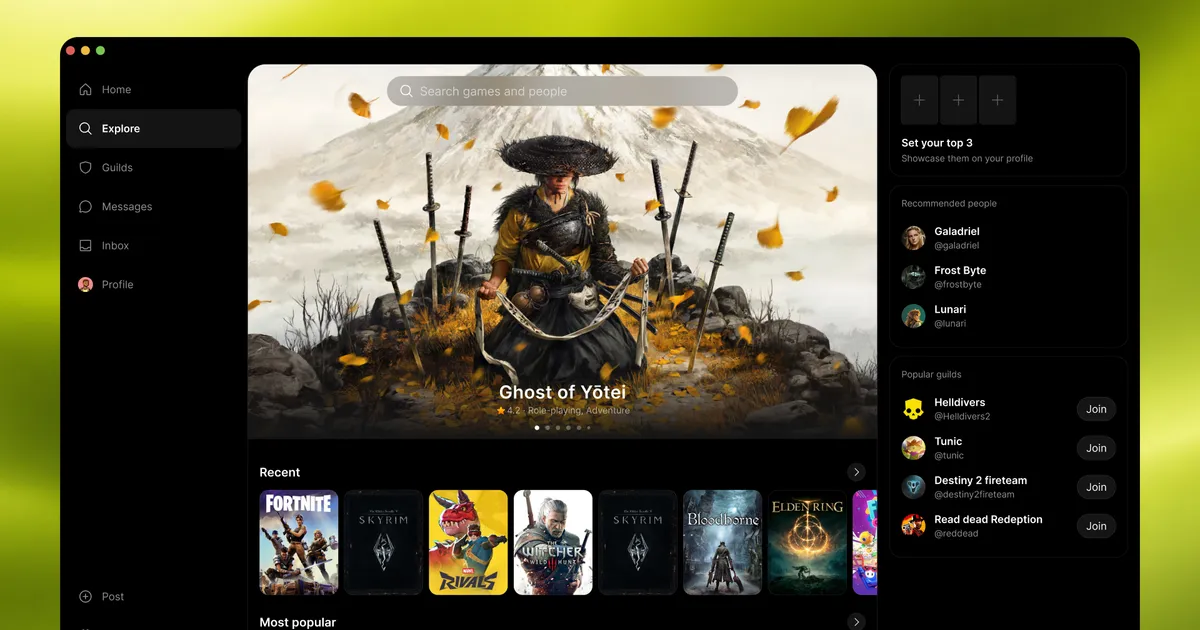
That is the thinking behind Lumin’s approach to profiles. Players can choose a defining top three, review games as a timeline not a snapshot and create ranked lists around whatever matters to them. Alongside clips, wishlists and guilds, those choices build a picture of someone through what they value, not merely what they play.
No top three can summarise a lifetime, and no list stays definitive forever. That is precisely why they work. The changes, omissions and contradictions make the profile feel selected by a person rather than generated from activity data.
Your gamer tag tells people what to call you. Your Lumin profile gives them a way to understand and connect with you.